









Bitcoin fell below $60,000 after a short-lived rebound failed to hold. The move coincided with another heavy day of withdrawals from US spot exchange-traded funds. November net outflows reached about $4.71 billion, exceeding the $4.5 billion record set in June 2026.
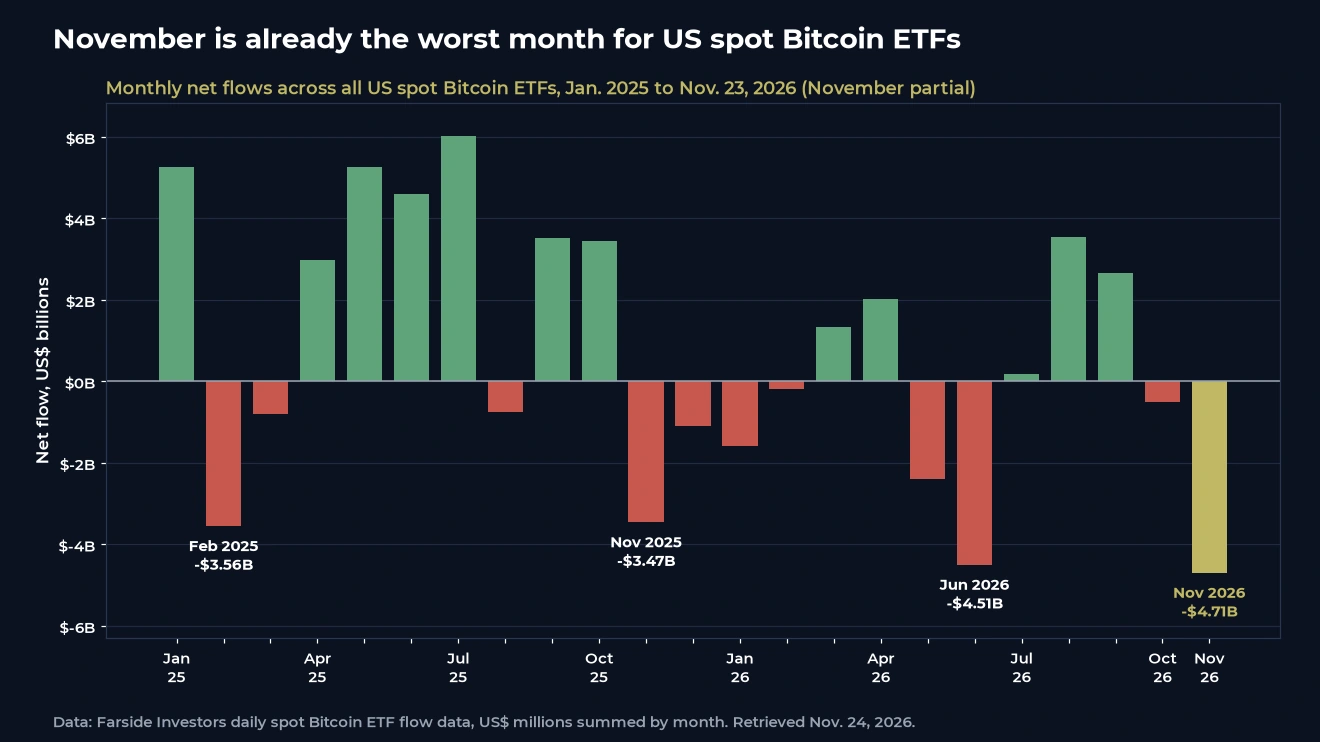
BlackRock’s IBIT accounted for roughly $509 million of the latest daily outflow, while the combined total for the funds was close to $570 million. These products are not the whole market, but they provide a visible measure of institutional demand. Persistent redemptions mean fund issuers must reduce exposure rather than absorb new bitcoin supply.
The rebound could not establish support above $60,000
Bitcoin had recovered from a two-year low near $55,250 and briefly traded above $60,000. The next decline showed that buyers were not yet strong enough to turn the rebound into a stable trend. A market can rise sharply after a sell-off because traders close short positions, even when longer-term demand remains weak.
The $60,000 level matters because it is easy for traders to identify and sits near the centre of the recent price range. Moving below it does not guarantee another collapse, but repeated failures to hold the level encourage sellers to test the previous low. A sustained recovery would require more than one strong hour of trading.

Fund flows and monetary expectations are moving together
ETF redemptions are arriving while investors also assess the possibility of tighter US monetary policy. Higher rates increase the return available from cash and government debt, reducing the attraction of assets that do not produce income. Bitcoin can still rise in that environment, but it needs a stronger source of demand to overcome the higher opportunity cost.
The next sessions will be judged by two signals. First, traders will watch whether the ETF outflow streak slows. Second, they will monitor whether bitcoin can recover $60,000 on meaningful volume rather than a brief spike. Improvement in only one measure may not be enough to change sentiment.
The market remains volatile and the quoted price can change quickly, so the article’s level should be treated as a snapshot rather than a fixed valuation. The central development is the record monthly withdrawal from spot funds. Until that pressure eases, every rebound will have to prove that it is supported by fresh demand rather than temporary positioning.
This article is for information only and is not investment advice.
 admin_wcContributor · World-CryptMore from